
Fibre Sensing: A technological revolution in monitoring and maintenance
Optical fibre, known primarily for its role in high-speed data transmission, is being reinvented through the concept of fibre sensing. This term encompasses a range of technologies that enable an optical fibre to act as a smart sensor capable of detecting physical anomalies such as vibrations, temperature, pressure or even deformations. The impact of this technology is immense, particularly in sectors where continuous monitoring and predictive maintenance are crucial. Let’s take a closer look at this promising innovation.
What is fibre sensing technology?
This technology transforms an optical fibre into a sensor network that spans long distances. By exploiting the physical properties of light travelling through the fibre, advanced techniques enable the measurement of environmental variations. Whether detecting temperature changes along a pipeline or underwater vibrations that could signal an intrusion, optical fibre can now be used to monitor a wide range of parameters in real time.
How does it work?
The technology is based on several sophisticated methods of analysing the light travelling through the fibre. The most common are:
1/ Fibre Bragg Gratings (FBG) : This system uses Bragg gratings etched into the fibre to reflect a specific wavelength of light. Changes in the environment, such as temperature or mechanical stress, cause a shift in the reflected wavelength, enabling these parameters to be measured.
2/ Distributed sensing (DTS, DAS, DVS, DTSS) : These methods enable the measurement of physical properties along the entire length of the fibre.
- DTS (Distributed Temperature Sensing) : Detects temperature variations over long distances.
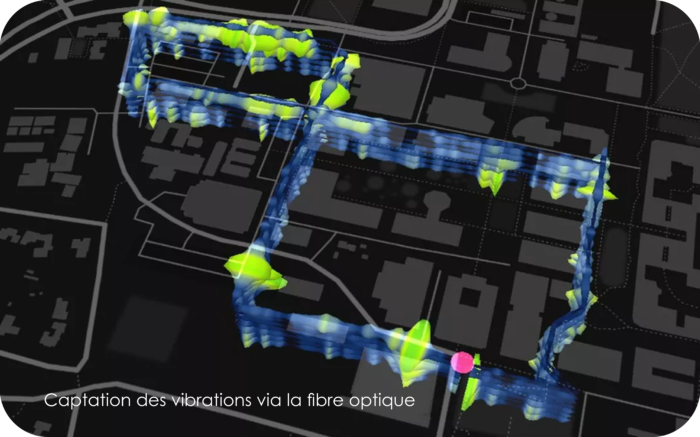
- DAS (Distributed Acoustic Sensing) : Detects acoustic vibrations and movements, useful for infrastructure monitoring.
- DVS (Distributed Vibration Sensing) : Enables the measurement of subtle vibrations over kilometres of fibre, making it ideal for detecting leaks or suspicious movements.
- DTSS (Distributed Temperature & Strain Sensing) : Enables the measurement of both strain and temperature along a fibre that can extend for up to a hundred kilometres.
Applications
The applications of fibre sensing are wide-ranging and have an impact on many industrial sectors:
- Infrastructure monitoring
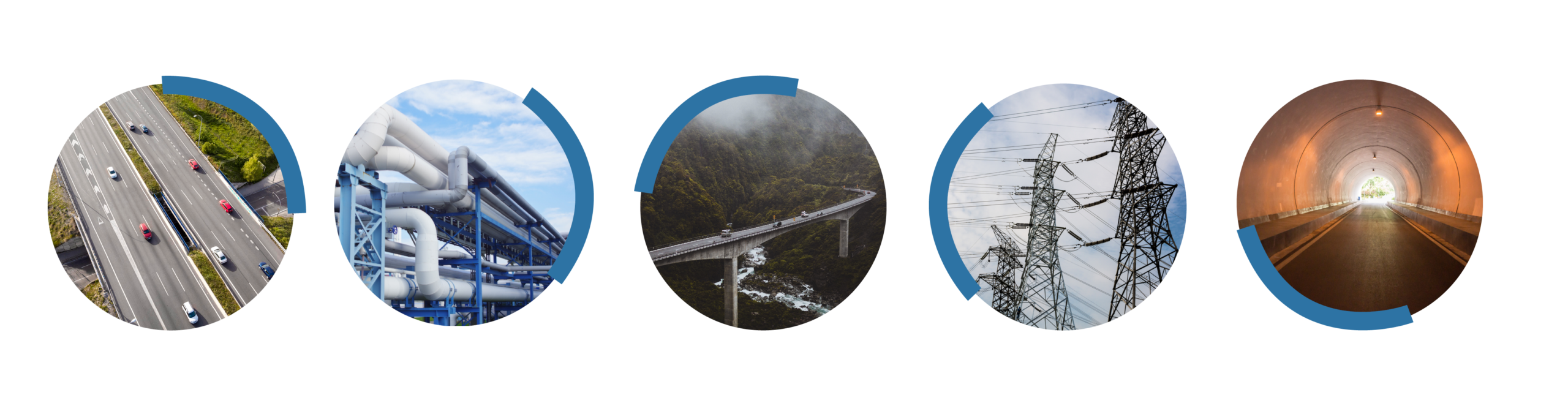
Critical infrastructure such as bridges, tunnels, dams and railway tracks can be monitored in real time. This technology enables the early detection of signs of deterioration, cracks or abnormal movements that could lead to accidents or failures.
- Security and intrusion detection
Fibre sensing is also used for intrusion detection at sensitive sites. Whether it is used to secure borders, industrial facilities or pipelines, it can detect vibrations caused by suspicious movements (such as a person approaching a protected area). The fibre can cover vast areas and be laid underground, on pylons or even in the ocean.
- Predictive maintenance in the energy sector
In the energy sector, particularly within electricity networks, fibre sensing enables predictive maintenance. By detecting temperature fluctuations and deformations in cables or high-voltage lines, it is possible to anticipate failures and take action before an incident occurs, thereby optimising maintenance costs and ensuring service continuity
- Monitoring of underwater pipelines and networks
Oil and gas pipelines, as well as submarine cables, can also benefit from fibre sensing. By measuring vibrations and temperature changes, it is possible to detect a leak immediately, before it becomes a major problem.
The benefits of fibre sensing
Its use offers a number of clear advantages over traditional detection systems:
- Continuous real-time monitoring: Enables instant detection of anomalies, with alerts sent in real time.
- Extensive coverage: A single optical fibre can cover hundreds of kilometres, offering an ideal solution for large-scale infrastructure or wide-area networks.
- Predictive maintenance and cost optimisation: By detecting early warning signs of failure, it enables maintenance strategies to be put in place before a major problem arises.
- Compatibility with various harsh environments: Optical fibres are resistant to severe weather conditions, humidity and other challengi
Fibre sensing is a rapidly growing technology with enormous potential to transform the way industries monitor and maintain their infrastructure. Its applications in sectors such as energy, transport, security and the oil industry make it an indispensable tool for the future of smart monitoring.
Thanks to its ability to provide accurate, real-time data over long distances, it is a valuable ally in risk management and the optimisation of industrial operations. As the challenges associated with infrastructure safety and maintenance multiply, this technology could well be the key to ensuring a safer, more reliable and more sustainable future.
D’AUTRES ACUATLITÉS QUI POURRAIT VOUS INTÉRESSER
Fiber Optics: Preventing Settlement of Backfill
Le
Optical fibre, known primarily for its role in high-speed data...
LIRE LA SUITE
April’s Featured Employee: : Asvinth RAGUNAN, quality engineer (work-study program)
Le
Optical fibre, known primarily for its role in high-speed data...
LIRE LA SUITE
March’s Featured Employee: Antony FLORES, Production Worker
Le
Optical fibre, known primarily for its role in high-speed data...
LIRE LA SUITE